How to Choose a Watch Band Colour: What Works for Everyday, Sport and Business
I have lost count of the number of times a customer has asked me the same question in a different way. They know the device they wear, they know the material they want, and then they stop at the colour chart. It is a fair place to stop. A watch band sits on your wrist all day, every day, and the colour is the first thing anyone notices. Get it right and the band disappears into your day in the best way. Get it wrong and you notice it every time you look down.
This guide explains how I help customers choose a colour for a screenless tracker band, what works for everyday wear, sport and business, and how colour behaves differently on nylon, silicone, leather and metal. Every figure in it is one we actually work to, and where a choice depends on your exact design, I say so plainly.
Start With Where You Will Wear It
Colour is not really about taste. It is about where the band will spend its day. Before you look at a chart, answer one question: will this band live at a desk, in a gym, or in both?
A band for the office needs to sit quietly next to a shirt cuff. A band for running needs to survive sweat and still look good after a wash. A band that does both needs a colour that can move between the two without looking wrong in either place. Most of the customers who come back to change a colour did not pick a bad colour. They picked a good colour for the wrong day.
Think about your week, not your favourite colour. If you wear the band to work five days and train twice, a dark or neutral colour will serve you better than a bright one. If the band is for a sports team or a weekend event, a bright colour makes sense because the band is meant to be seen.
Dark, Neutral or Bright: The Three Colour Families
Almost every colour on a chart falls into one of three families, and each family behaves differently on the wrist.
Dark colours are the safest choice. Black, dark grey and dark navy go with most clothes, hide small marks, and look tidy in a meeting and in the gym. If you only want one band, start with a dark colour.
Neutral colours are the quiet middle. Grey, beige and soft earth tones match almost anything and never shout. They are a good choice when you want the band to feel like part of your outfit rather than the main event. The trade off is that a neutral band can look plain if everything else you wear is neutral too.
Bright colours are for energy. A bright band is easy to find in a bag, easy to spot in a team photo, and fun to wear. It is also the hardest family to wear with formal clothes, so bright works best as a second band or for sport.
| Colour Family | Best For | Feels Like | Watch Out For |
|---|---|---|---|
| Dark | Everyday, sport, business | Quiet, goes with most clothes | Shows dust and light lint on some fabrics |
| Neutral | Everyday and business | Calm, easy to match | Can look plain if the whole outfit is neutral |
| Bright | Sport and team wear | Energetic, easy to spot | Harder to wear with formal clothes |
My rule of thumb is simple. One band: dark. Two bands: one dark and one bright. Three or more: add a neutral, and the set will cover almost any day.
Match the Colour to the Material
The same colour looks different on different materials, and this is where most surprises come from. A colour you love on a screen can look softer on woven nylon and flatter on silicone. Here is how colour behaves on the materials we make.
Nylon woven bands take colour into the weave, so the colour looks soft and deep in normal light rather than flat. Our nylon woven range runs to 37 numbered colours on one chart, which is why it suits customers who want a precise match to a brand colour or a team colour. Dark and neutral tones wear very well in nylon, and bright colours look strong in the weave without looking harsh.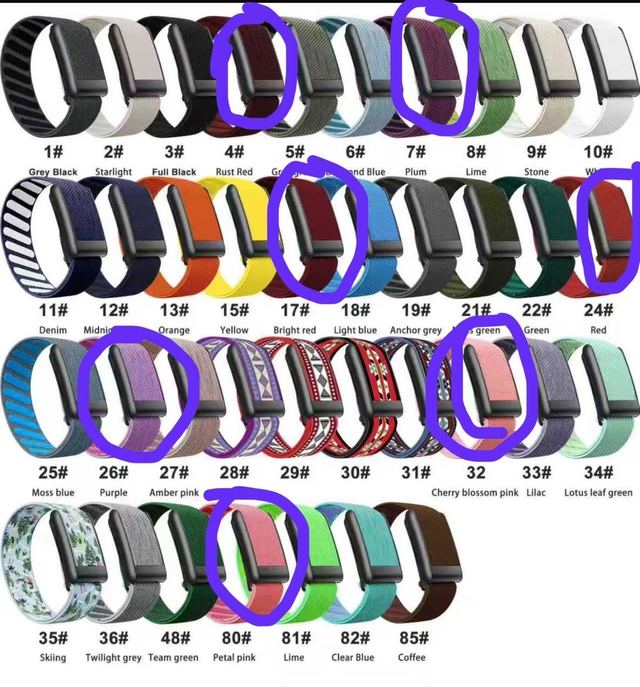
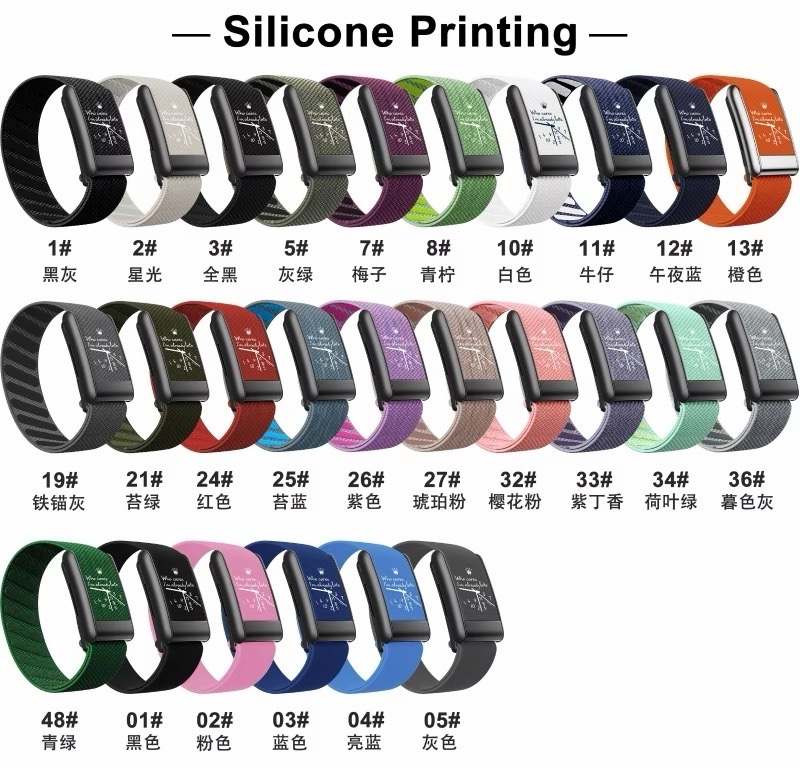
Silicone bands show colour flat and even, and they are easy to wipe clean after sport. Our silicone printing chart shows 26 colours. Bright colours stay bright on silicone, and dark colours hide sweat marks well, which is why silicone is a popular choice for training bands.
 Leather changes with wear. The colour deepens a little over time and each piece ages in its own way, so a leather band rarely looks exactly the same after a month as it did on day one. Neutral and dark tones age best in leather. Bright leather looks striking at first but shows marks sooner, so it suits a band that is worn for looks rather than hard use.
Milanese steel and titanium are metal bands, and the colour comes from the metal finish itself rather than from dye. The finish is part of the design, so the choice is about the metal tone and how it sits next to a watch case. If you want a metal band to match a brand colour, the logo or the clasp is usually the better place for that colour, not the mesh itself.
| Material | How Colour Shows | Best Colour Approach |
|---|---|---|
| Nylon woven | Colour sits in the weave, soft in normal light | Dark and neutral wear well; bright looks strong in the weave |
| Silicone | Colour looks flat and even, easy to wipe clean | Bright stays bright; dark hides sweat marks |
| Leather | Colour deepens with wear, each piece ages a little differently | Neutral and dark age best; bright shows marks sooner |
| Milanese steel | Colour comes from the metal finish | Keep to metal tones; put brand colour on the logo or clasp |
| Titanium | Natural metal tone with a matte finish | Let the metal speak; the finish is the colour choice |
If you are choosing between two materials in the same colour, ask for a sample of each. A photo will not show you how the weave, the silicone or the leather changes the colour in real light.
Colour and the Device on Your Wrist
Colour does not change how a band fits, but the device does, and this is the mistake that costs customers the most. WHOOP 4.0, WHOOP 5.0 and WHOOP 5.0 MG have different interfaces and do not fit each other. A band made for one model will not fit another, whatever colour it is. Some designs also come in S/M and M/L wrist sizes, so the size matters as well as the model.
Before you choose a colour, confirm the exact device model in your order. If you are ordering for a group, check the model for every person, because a mixed group often wears more than one model. A colour chart will not save an order that was made for the wrong device, and a return for the wrong model is the most common return we see.
My advice is to settle the model first, the size second and the colour third. In that order, nothing gets wasted.
How to Test a Colour Before You Order in Bulk
The cheapest way to choose a colour is to see it on your own wrist before you order in bulk. A sample shows the real colour in normal light, the real feel of the material, and the real fit on your actual device. No photo and no chart can do that.
A standard sample generally costs $50 to $70 and generally takes 15 to 20 days. Stainless steel part CNC sampling is about $150. If your design is a fully new strap shape, it needs a brand new mould, which costs about 20,000 RMB and needs a 1,000 piece minimum order, so a new shape is not the way to test a colour. Start with an existing design and your colour on it.
When the sample arrives, check it in this order:
- Look at it in normal daylight, not only under a shop light or on a screen.
- Put it on the actual device and wear it for a day.
- Hold it next to the clothes you wear most often.
- Check the logo size and placement if the sample carries your logo.
- Decide quickly and tell us what to change, if anything, before the bulk order starts.
If the colour is wrong on the sample, it will be wrong on five hundred bands too. A sample is a small cost that prevents a large mistake.
Colour for Wholesale and OEM Orders
Colour works differently when you order for a shop, a team or a brand, because you are choosing for many wrists at once, not just your own. The good news is that colour does not change the ordering rules.
Standard custom work, such as a laser engraved logo, embroidery, corrosion etching or a sewn woven label, can be done from 1 piece on an existing design. That means you can order one band in your brand colour with your logo on it and check it before you commit to a larger order. A fully new strap shape is different: it needs a brand new mould and a 1,000 piece minimum order, so keep new shapes for orders where the volume is already certain.
As a rough guide, 20 to 50 pieces run about $10 to $15 per piece, with each higher quantity tier about $1 less per piece. The exact price depends on the design, the material and the quantity, so send those details for a real quote. Ordinary bulk orders generally take 10 to 20 days. A brand new mould order generally takes 25 to 40 days, depending on how smoothly the mould is made.
For a shop or a team, order the safe colour first and the bright colour second. Dark and neutral bands sell first in most shops because most customers buy for everyday wear. Bright bands sell well as a second purchase and as team wear, where one shared colour makes the group easy to recognise. If you are ordering several colours of the same design, keep the design and the size the same across the colours so your stock stays simple.
The bands are made in our own factory in Dongguan: 108 people, 10 production lines, about 350,000 straps a month, with RoHS, REACH, EN71, CE and ISO 9001 certification. We sign NDAs with customers as a matter of course, so a design you send us stays yours. Factory visits are welcome with 1 day's notice. Payment can be made by TT or wire transfer, PayPal, Western Union, cryptocurrency, credit card or cash, plus Alipay and WeChat Pay.
| Situation | Colour That Works | Why |
|---|---|---|
| Daily office wear | Dark or neutral | Matches most clothes, looks tidy |
| Running and gym | Dark or bright | Hides sweat marks, bright is easy to spot in a bag |
| Business meetings | Dark or neutral | Quiet, does not draw attention |
| Team or club orders | Bright, one shared colour | Easy to recognise as a group |
| Gift or retail | Neutral with a bright option | Neutral sells first, bright catches the eye |
Common Colour Mistakes
Most colour mistakes are easy to avoid once you know them. Here are the ones I see most often.
The first is choosing a colour from a screen alone. Screens make colours look brighter and cleaner than they look in real light. Always check a sample or a colour chart in normal light before you order in bulk.
The second is ordering a bright colour for a formal setting. It is not a bad colour, it is just in the wrong place. Keep bright for sport and for fun, and keep dark and neutral for work.
The third is forgetting the device model. Colour will not fix a band made for the wrong model, and a wrong model order is a return, a refund and often a lost customer. Confirm WHOOP 4.0, WHOOP 5.0 or WHOOP 5.0 MG, and the wrist size where the design comes in sizes, before you choose the colour.
The fourth is ordering too many colours at once for a first order. Three colours of one design is a good test. Ten colours of a new design is a warehouse problem. Start small, see which colour sells, and reorder the winner.
Frequently Asked Questions About Watch Band Colours
Q: How many colours can I choose from?
A: Our nylon woven range runs to 37 numbered colours on one chart, and our silicone printing chart shows 26 colours. For leather, Milanese steel and titanium, the choice is in the material finish, so ask us what is available for the design you want.
Q: Does the colour change how the band fits?
A: No. Fit comes from the device interface and the wrist size, not from the colour. WHOOP 4.0, WHOOP 5.0 and WHOOP 5.0 MG have different interfaces and do not fit each other, and some designs come in S/M and M/L wrist sizes. Confirm the model and the size first, then choose the colour.
Q: Which colour is best for sport?
A: Dark or bright, on silicone or nylon woven. Dark hides sweat marks and bright is easy to spot. Silicone wipes clean after training. Order a sample first and wear it for a training session before you order in bulk.
Q: Can I get my logo in a colour that matches my brand?
A: Yes. Standard custom work, laser engraving, embroidery, corrosion etching and a sewn woven label, can be done from 1 piece on an existing design. Send the artwork you own or have the right to use, tell us where the logo should go, and we confirm the size and the placement before the band is made.
Q: Can I order the same design in several colours?
A: Yes, on an existing design. Order the safe colour first and add bright colours once you know the design sells. A fully new strap shape needs a brand new mould and a 1,000 piece minimum order, so keep new shapes for orders where the volume is already certain.
Q: What if the colour looks different from the photo?
A: Order a sample before the bulk order. A standard sample generally costs $50 to $70 and generally takes 15 to 20 days. Check it in normal daylight and on the actual device. If the colour is not right, tell us what to change before the bulk order starts.
One Last Thought Before You Choose
Colour feels like a small decision, but it is the decision you live with every day. My advice is to keep it simple: settle the device model, then the size, then the material, and let the colour follow the life the band will actually live. One dark band will cover most days. A bright second band will cover the rest. And a sample, checked in daylight on your own wrist, will tell you more than any chart ever will.
Send us the design, the device model and the colour family you have in mind, and tell us how many pieces you need. With those details, we can confirm the colour, the price and the delivery, and you can order with confidence.
Explore custom watch bands and OEM/ODM options at WhoopStrap.com
WhoopStrap.com is an independent accessory supplier and is not affiliated with WHOOP. WHOOP is a trademark of its respective owner. Check product compatibility before ordering.